From production to the quality lab.Verify every sample handover.
Connect production, receiving, inspection, retesting and retained-sample storage with manual packaging, authorized handovers and task records.
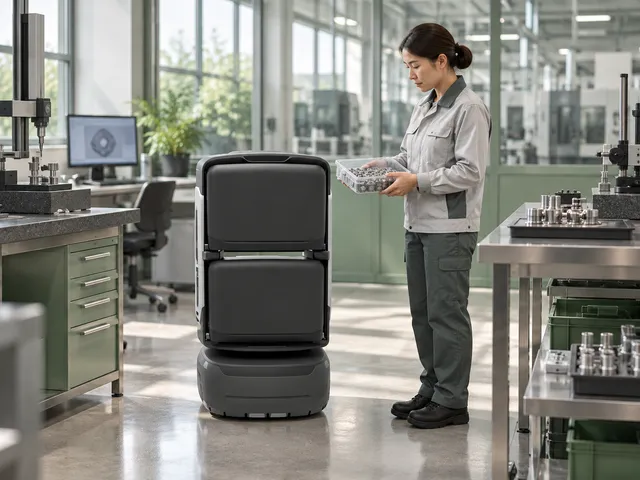
Select items, destination and required time.
Follow configured routes and access rules.
Receive the arrival alert, use configured access and verify receipt.
Where the service helps
Reduce repeated trips around these tasks and define on-site handovers.
Indoor small robot
Frequent small samples within one building.
Cross-building large robot
Optional campus routes and larger batches.
Authorized handover
Choose QR, badge, password or remote authorization per project.
Dispatch large and small robots independently with staff transfers when needed. Automatic transfer and active temperature control are not included; staff own packaging, labels and quality decisions.
Service flow and ownership
Robots execute configured tasks; responsible staff retain verification and on-site response.
Select items, destination and required time.
Check items, packaging and compartments; load manually and confirm.
Follow configured routes and access rules.
Receive the arrival alert, use configured access and verify receipt.
Review completion, exceptions and handover records.
Confirm execution separately from human handover/review; assigned staff take over exceptions.
Roles
Dispatch and receiving staff
Request, prepare, load, verify and acknowledge receipt.
Robot
Transport, notify and return status within the configured scope.
Management and support
Maintain points, schedules, equipment, exception handling and records.
Service modes
Select modes for the workflow; agree extensions separately.
Indoor small robot
Frequent small samples within one building.
Cross-building large robot
Optional campus routes and larger batches.
Authorized handover
Choose QR, badge, password or remote authorization per project.
Dispatch large and small robots independently with staff transfers when needed. Automatic transfer and active temperature control are not included; staff own packaging, labels and quality decisions.
Scenario fit
Connect production, receiving, inspection, retesting and retained-sample storage with manual packaging, authorized handovers and task records.
Indoor small robot
Frequent small samples within one building.
Cross-building large robot
Optional campus routes and larger batches.
Authorized handover
Choose QR, badge, password or remote authorization per project.
Terminals and configuration
Document-based scope; confirm supplied model, options and site fit.
Delivery terminal
Configure compartments for sample containers, routes and batches.
Management
Tasks, devices, access and node records; choose networked or local deployment.
Coordination priorities
Assign suitable repeated routes to robots and compare results in the pilot.
Verify outcomes against task, destination and responsible role.
Use task states and exception records to adjust routes, schedules and configuration.
Routes and service points
Configure routes for the actual site; diagrams explain the workflow.
Production / receiving
Package, label and bind samples to tasks.
Inspection / retest lab
Verify receipt and manage testing transfers.
Retention / return
Retain or return samples as instructed.
Locations
- Production / receiving
- Inspection / retest lab
- Retention / return
Diagrams explain the flow; survey actual passages, thresholds, access and stops.
Site readiness and operations
Confirm site, equipment and staffing; verify interfaces per project.
Document pilot targets
Average end-to-end response ≤15 minutes, ≥98% success and full node traceability require defined measurement and validation; these are not established results.
Human fallback
Pause for damaged packaging, mismatched labels or failed handovers and contact the owner.
Commission configured interfaces, notifications and access; assign site contacts and staff fallback.
Document configuration and device checks
| Delivery terminal | Configure compartments for sample containers, routes and batches. |
|---|---|
| Management | Tasks, devices, access and node records; choose networked or local deployment. |
Document and current product versions may differ; confirm supplied specifications and project configuration.
Pilot and expansion
Pilot a workshop A–receiving–laboratory loop before adding retesting, retention and cross-building routes.
Delivery terminal
Configure compartments for sample containers, routes and batches.
Management
Tasks, devices, access and node records; choose networked or local deployment.
Suggested sizing assessment
Effective deliveries = completed round trips × actual orders per trip × site adjustment factorUse site data including access, handover, waiting, charging and exceptions; travel speed alone does not establish capacity.
This is an assessment method; source recommendations/targets are not universal performance guarantees.
Sizing considerations
Task cycle
Measure request, execution, handover, return and charging time.
Site scope
Production / receiving, Inspection / retest lab, Retention / return
Staff coordination
Allow for available receiving, reviewing and exception-response staff.
Source configurations/data refer to their stated scenario; confirm final sizing through site validation.
Suggested implementation
The following are project assessment and acceptance suggestions, subject to site confirmation.
Confirm scope
Site preparation
Configure and commission
When ready
Trial and acceptance
By project agreement
Suggested exception handling
The following are project assessment and acceptance suggestions, subject to site confirmation.
| Condition | Action | Ownership and records |
|---|---|---|
| Task cannot continue | Pause, wait or hand over to staff under site rules. | Managers record cause, owner and recovery conditions. |
| Handover/review incomplete | Contact the assigned staff; automatic task closure does not replace their confirmation. | Record the reason and follow-up. |
| Device/access exception | Follow support procedures and use staff service if required. | Support and site staff coordinate and validate recovery. |
Common questions
Where should the pilot start?
Pilot a workshop A–receiving–laboratory loop before adding retesting, retention and cross-building routes.
How do robots and staff share work?
Dispatch and receiving staff:Request, prepare, load, verify and acknowledge receipt. Robot:Transport, notify and return status within the configured scope. Management and support:Maintain points, schedules, equipment, exception handling and records.
What needs separate confirmation?
Dispatch large and small robots independently with staff transfers when needed. Automatic transfer and active temperature control are not included; staff own packaging, labels and quality decisions.
How are configuration and acceptance set?
Use source recommendations as a starting point, then confirm against site routes, supplied equipment and trial data. Suggested checks do not establish fixed performance or service guarantees.
Pilot preparation
Pilot a workshop A–receiving–laboratory loop before adding retesting, retention and cross-building routes.
| Item | Scope | Confirmation |
|---|---|---|
| Scope and points | Production / receiving, Inspection / retest lab, Retention / return | Confirm accessible scope and responsible staff on site. |
| Routes and access | Maps, passages, doors/lifts, network and charging. | Commission cross-floor and controlled-door access as needed; diagrams do not replace site tests. |
| Handover and exceptions | Dispatch and receiving staff, Robot, Management and support | Agree notifications, staff takeover, records and review rules. |
Scope and points
Production / receiving, Inspection / retest lab, Retention / return Confirm accessible scope and responsible staff on site.
Routes and access
Maps, passages, doors/lifts, network and charging. Commission cross-floor and controlled-door access as needed; diagrams do not replace site tests.
Handover and exceptions
Dispatch and receiving staff, Robot, Management and support Agree notifications, staff takeover, records and review rules.
Related equipment
Review product information and reconcile the document version with the supplied model/configuration.
Related solutions
Choose a dedicated solution for each workflow.
Production-line material and tool delivery
Transport standard materials, tools and empty containers through requests, preparation, loading, delivery, human checks and records.
Explore Solution →Factory air and odor patrol solution
Collect air readings along workshop, storage and shared-corridor routes, revisit anomalies and let staff review and respond.
Explore Solution →Factory indoor security patrol
Robots patrol, collect and notify; the platform unifies records and enterprise staff decide and respond.
Explore Solution →