Robots and buildings, working together.
Continuous service inside a building involves travel between floors, shared resources and material handover. YOGO brings lift AIoT, Mesh-based fleet coordination and adaptive docking into one system design, connecting equipment state, movement decisions and mechanical actions across the complete journey.
Three interfaces underpin continuous operation
A transfer between floors passes through several transitions: travelling from the loading point to the lift, waiting for shared access, boarding and handing over at the receiving point. Each transition has its own conditions. Reaching a lift does not establish its availability; stopping beside a rack does not establish transfer readiness. Position, equipment state and handover state need separate confirmation.
YOGO addresses these transitions through three interfaces. Lift AIoT connects facility state and access actions; Mesh networking supports information exchange between robots; and the transfer module establishes the mechanical connection to a rack. Facility integration, resource coordination and physical handover become distinct responsibilities linked by task state.
Lift AIoT: connecting movement between floors
A lift is a shared building resource. To use it as part of a service route, a robot needs coordination with the facility as well as a route to the lift entrance.
Lift AIoT forms a feedback loop across sensing, communication and execution. Sensing supplies equipment state, communication carries requests and state changes, and the execution interface connects agreed actions such as calling a lift or selecting a floor. The robot uses facility feedback to organise waiting, boarding and departure, alongside onboard observations of the doorway and surrounding space. A command acknowledgement and permission to move are separate conditions.
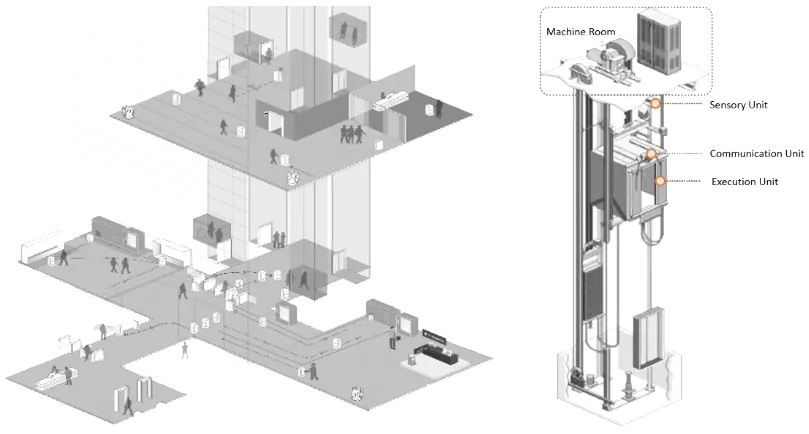
- Sensing
- Acquire relevant facility observations and associate them with the equipment and task stage.
- Communication
- Carry equipment state, access requests and result feedback between robots and facilities.
- Execution
- Request facility actions through an agreed interface and use subsequent state to confirm their outcome.
4G + 2.4 GHz: more than one communication path
Lift lobbies, shafts and floor boundaries present different radio conditions. YOGO uses 4G and 2.4GHz channels to address remote-service connectivity and nearby device interaction, with Ad-Hoc networking supporting direct information exchange among devices on site.
- Dual-channel communication
- The two channels provide different connection paths. Assessment should cover car movement and changes between floors, including message validity and outstanding requests after a connection change. Coverage, interference and device configuration determine the resulting connectivity.
- Ad-Hoc networking
- An Ad-Hoc network lets nearby devices communicate directly, reducing reliance on a remote path for local exchanges. Network membership, device identity and message timing need to correspond to the task so that received information can support the current action.
Site fit: YOGO uses a non-invasive installation approach. Lift models, interfaces, access permissions and radio coverage still need to be checked with the building team and tested on site.
Fleet coordination: shared information, coordinated passage
Fleet operation is constrained by shared resources: lift service, an occupied gate passage and limited waiting space at a lobby. Beyond each robot’s navigation, coordination needs an order for using those resources and conditions for releasing them.
YOGO uses Mesh networking to share relevant information among robots and building devices, supporting queuing, obstacle avoidance and coordinated access. Connectivity delivers state; the operating strategy uses position, resource occupancy and access rules to decide when movement can proceed. Following an update, subsequent tasks need to reassess the current conditions.
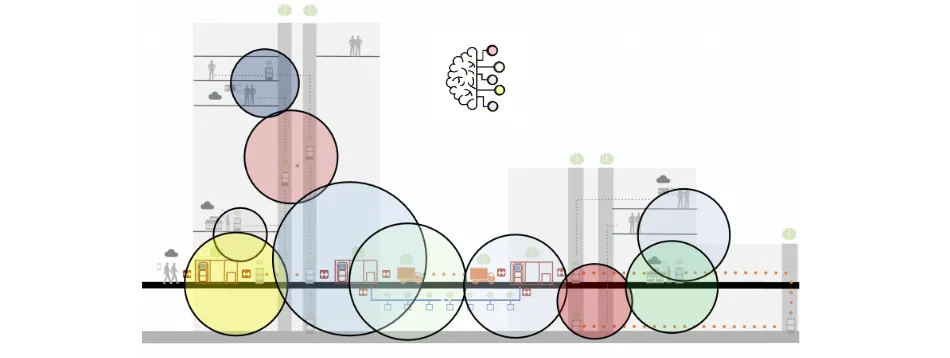
From a local network to connected groups
A single Mesh group organises communication among nearby devices; connections between groups extend the information scope across floors and areas. Immediate local state and task information from other areas retain different roles: the former affects current passage, while the latter informs later routes and task allocation. This keeps coordination responsibilities clear as information sharing expands.
An example at a shared passage
Share the situation
Check relevant robot positions, facility state and passage occupancy for the current stage.
Coordinate the order
Allocate waiting positions and passage order against available space, equipment capacity and pedestrian-priority rules.
Move and update
Update occupancy after passage, departure or cancellation so that subsequent devices can use the resource.
Fleet operation requires verification of both communication and traffic organisation. Robot count, lift capacity, pedestrian activity and waiting space affect task completion. Network size alone does not determine transport capacity; capacity assessment needs the complete task route and representative site demand.
Decoupled pickup and delivery: connecting movement with transfer
Decoupled pickup and delivery separates mobile transport from fixed handover points. The robot carries items along the route, a matching rack provides loading, receiving or storage positions, and dedicated mechanisms transfer items between them. Docking pose, mechanical engagement and transfer confirmation are the core automation tasks.
YOGO’s adaptive docking combines navigation, mechanical adjustment and sensor feedback. Navigation brings the robot into the docking area, the mechanism accommodates height and fore-aft alignment, and sensors provide engagement feedback. These stages progressively resolve positioning differences between route-level movement and the local alignment required by the transfer interface.
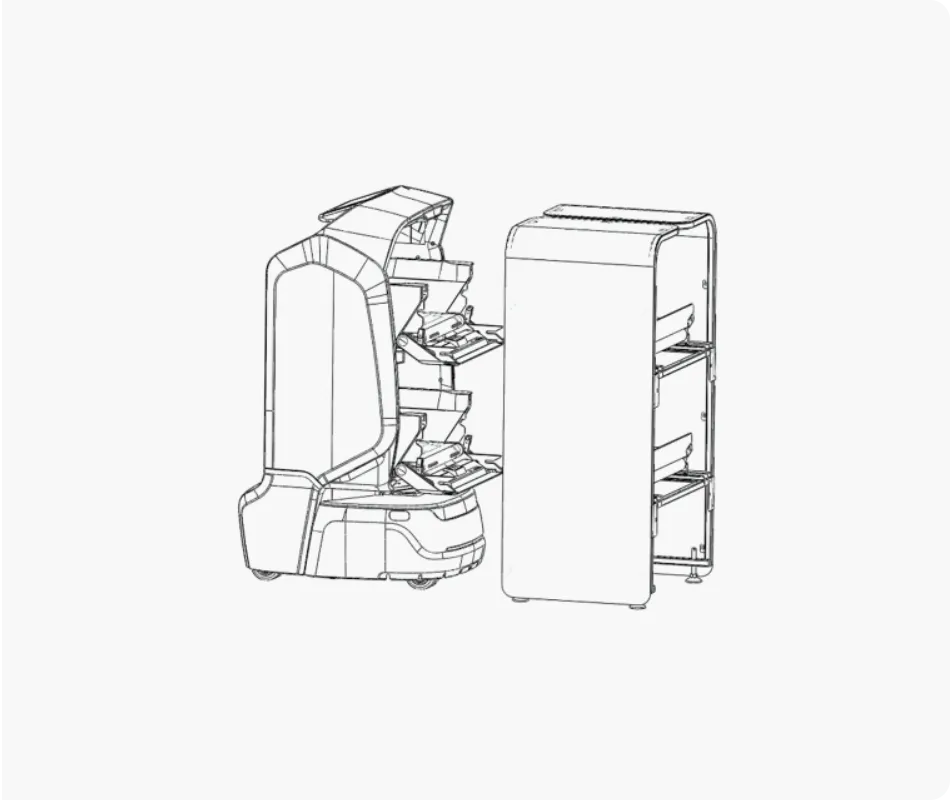
Approach and communicate
At the docking point, communication coordinates opening the door that contains the docking mechanism.
Align to the rack
The robot identifies reflective strips on the rack and uses navigation movement to adjust its forward, backward and lateral position.
Adapt the connection
The matching mechanisms accommodate height and fore-aft alignment, helping the two sides adapt to floor conditions.
Confirm through feedback
Sensors on the robot’s transfer module detect the rack’s docking rod, closing the feedback loop for the docking movement.
Docking establishes the path for material transfer
After docking, the robot drives the rack conveyor through the drive-wheel coupling at the interface. Positioning establishes the spatial relationship, mechanical engagement creates the drive path, and the conveyor moves the item. Docking feedback, transfer action and the item’s resulting position need distinct confirmation to establish progress and support the next action.
A fixed handover point also separates staff preparation from robot transport. The two stages exchange items through the same receiving position without necessarily arriving together. The available time buffer depends on rack configuration, free positions and service rules, making occupancy part of route design alongside physical transfer.
Applicable configuration: a compatible robot, transfer module and rack are required. This is separate from opening a standard compartment for someone to load or collect items manually. Item dimensions, packaging, load and installation tolerances need to match the selected equipment.
From connected components to a complete service
Continuous operation depends on verifiable completion conditions at each transition: facility access is available, a shared resource has been released and a handover has been confirmed. The three technologies provide the relevant interfaces, while the task flow establishes their order.
- Between floors
- Lift AIoT connects the robot with building facilities.
- Between robots
- Shared information supports coordinated use of passages and facilities.
- Between robot and rack
- Adaptive docking connects mobile transport with material transfer.
The engineering task is to align the physical route, equipment interfaces and task state. Assessment starts with the complete journey, identifies conditions for facility access, shared passages and automatic transfer, then checks them through interface tests and continuous task trials. This provides a basis for deploying and maintaining robot service inside an existing building.